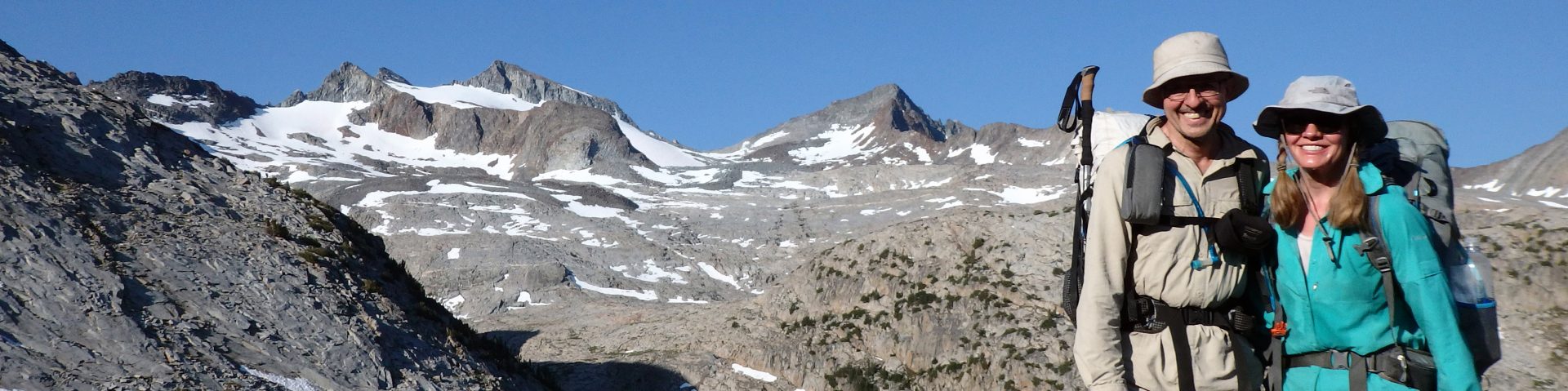

March of 2021, we crawled out of our Pandemic stupor determined to have an adventure outside of four walls. It seemed like a good plan. Head to the most remote part of the Water Pocket Fold in Glen Canyon National Recreation Area (Utah) and spend a few days exploring canyons rarely visited. Little did we know that this trip would challenge us in ways we didn’t expect.

It’s not like we weren’t warned about difficulties hiking in this area. Steve Allen, in his Canyoneering 3 book states “A lack of water, difficult route finding, hazardous rock climbing, and long distances make this only suitable for hardcore canyoneers who are rock climbers”.

While Ray and I don’t fit Allen’s criteria of being “hardcore canyoneers who are rock climbers”, we are experienced backpackers who are good at navigating without a trail. Besides, we had been in that area two years ago and know what is out there. Good enough for me, or so I thought.

The Plan
We decide to bring 8 days of food with us. We would head cross country and drop into Hall’s Creek south of Capitol Reef National Park. We knew there was water at the “Big Foot” Canyon we had been to before. “Big Foot” is a canyon in the Water Pocket Fold that drains into Halls Creek. It has a common name but we sometimes refer to areas with names that mean something to us. We would camp there the first night.
The second day would be long, hard and dry. We planned to hike up the Water Pocket Fold using the Baker’s Route and then head cross country to the head of Bowns Canyon. We had done this previously and had found large potholes of water in the sandstone at the head of Bowns. Although it was 18.5 miles and a push to get there without a trail and water, these potholes would provide us with water the second night.

The third day we would hike into Bowns using an old cowboy route we had found before and hike around to Long Canyon by following Kayenta ledges. Water again would be tricky but we could perhaps get to Lake Powell if the water level was not too low. We had also found water near the junction of the two branches in Bowns two years earlier.

Once in Long Canyon, we would camp for nights four and five and take a day to explore the pool at the end of the canyon, get water, and find the hidden passage to the canyon top. Day six would involve climbing out of the canyon using the hidden passage and heading back across the open and dry country to Big Foot Canyon. Day seven would be climbing out of Halls Creek and back to the car. Day eight would only be needed if we couldn’t find the hidden passage and had to backtrack the way we came.
What Really Happened
Day 1: Vehicle to Big Foot Canyon
Distance: 7 miles
Ascent/Descent (ft): 845/1167
It was a great spring day in March when we started. Clear, in the 50s, with that cold breath of wind reminding us that winter was not yet completely gone.

We got started by 9am and it was pretty easy to navigate cross country to the edge of Halls Creek Canyon. We crossed two drainages that required some up and down over ledges but could see the large cut of the drainage we were heading to in the distance. Our goal was to make it to Big Foot Canyon the first night which has perennial water. On the way to Big Foot Canyon, we passed by two key markers for the route: a mushroom-shaped rock at approximately 1.5 miles to 2 miles and an arch at approximately 3.5 to 4 miles from the vehicle.
These two markers are good reminders that you are on track.


The last part of the hike today required a drop into Hall’s Creek through the cliffs. It is marked with cairns and has a few places with drops and some exposure but nothing that required taking off the pack or a hand line. We did spend a little time looking for it at the top of the cliff and meandered along an edge partway down but it was overall straightforward.


We arrived at Big Foot Canyon and set up camp. Big Foot Canyon has flowing water and we have found it to be a dependable camp spot in the past.

As we got ready to go to sleep, I remarked to Ray, you know, this campsite is the backcountry site we have stayed at the most. This is our sixth night staying here. We stayed here on a trip in 2012 where we explored the Hall’s Creek narrows and a few other drainages off the Water Pocket Fold. We also stayed here while hiking the 800+ mile Hayduke Trail in 2018, and again in 2019 when we headed to Bowns Canyon. It feels like home.
Day 2: Big Foot Canyon to top of Bowns Canyon
Distance: 18.8 miles
Ascent/Descent (ft): 2450/2008
Day two is a push and I feel it all day. We have to hike over 18 miles, mostly off trail, across the big, open and dry sandstone dunes of the Navajo Formation. The Navajo Sandstone is an amazing geologic wonder in the west extending through southern Nevada, northern Arizona, northwest Colorado, and Utah. It mostly occurs as spectacular domes, and bluffs with gigantic cross beds that tell us about ancient winds and deserts like the Sahara. It is usually white or pink but can be yellow, tan or red depending on the groundwater fluids that moved through it after burial. Think “Bee Hives of Zion National Park”. The Navajo Sandstone is estimated to be 180-190 millions years old based on dates from zircons in the sand.

Our goal today is to reach potholes at the top of Bowns Canyon where drainages funnel across the sandstone and narrow into drop and pools that go to a pour off into the canyon.
We had been in this area two years ago where we had found plenty of water in potholes as big as backyard swimming pools in Phoenix, AZ.

Ray and I take turns navigating. You have to be “on” when you are navigating. It is all about paying attention, looking at the Gaia route on the phone, picking the direction, and observing your surroundings. If you are following and not navigating, you can relax a little more, and it is less taxing.
By late afternoon, we still have about 5 miles to go. Ray has been navigating all day and I can tell he is getting tired. I take over and just keep thinking about those big potholes of water in front of us. We both go into “will power will get us there” mode.


By 6pm we are about 2 miles from our destination and I spot a shimmer in the distance below a crack. “There may be water there if we need it” I say to Ray. It is mainly out of habit we do this. In the desert, these kind of observations can save your life. But neither one of us are thinking we need it and we don’t look that closely at it. We have those big potholes ahead where we plan on camping. Or so, we thought.
By 7pm, we are passing by the potholes we had looked forward to. One by one, we pass by them and they are bone-dry. I feel a pit of fear in my stomach. Both of us begin to realize how serious a situation we are in.

We are 18.5 miles from where we last had water and are down to less than a liter each. There is little chance we can get back across the desert on the water we have. We get to the camp spot and throw up the tent.

“We’ve got to find water”, we both agree. We decide to separate and each go up different drainages to look for water. We have about 1 hour of daylight left. We begin to search as dusk falls. I think to myself “at what point do we send out an SOS in our Garmin Inreach?” And “what do I tell family and friends when we send a message out tonight?” I can’t say “checking in, everything is ok” because it’s not ok. I also don’t want to worry them and say “we will die of thirst if we don’t find water soon”. But the possibility of dying of thirst becomes more likely. We do not find water and head back to the tent as darkness sets in.

We eat a few bars and drink a few swallows of water in the tent. I send out an Inreach message trying to convey the concern without worrying family and friends too much. I mention that we hiked to what we thought was a dependable water source but it is a no go. My last sentence is “we will evaluate our water options tomorrow”. I want to say “I love you all. I just wanted you to know, in case we don’t make it”. I still wonder if I should have said that anyways.
Day 3: Bowns to Cowboy Camp on Navajo Sandstone
Distance: 15.6 miles
Ascent (ft): 2,322
The next morning, Ray and I strategize about our options. We throw our trip plan out the window and take a few swallows of our last water. Forget about beautiful canyons with pools and hidden passages. It is down to whether we will survive or not. We have to find water NOW and get back across the desert.

We go back and forth between do we go further into Bowns Canyon where there had been a spring two years earlier or do we backtrack to where I had seen that “shimmer” off in the distance I thought was water. We wonder if the spring in Bowns Canyon down canyon a few miles is dry based on how our trip has been so far. We could also hike 8 miles down Bowns Canyon to Lake Powell but with the water levels in Lake Powell extremely low, there could be a drop off that won’t allow us to get to the lake. So what about the “shimmer”? Was that really water I saw two miles back when I pointed out that shimmer off in the distance? If there is water there, would it be enough to keep us from dehydration and maybe dying of thirst?
We decide to go back to the “shimmer”. If it doesn’t have any or much water, we will have to turn around and head into Bowns Canyon with an added four miles of hiking dry. We pack up and take our chances on the shimmer having water.

It is a cool morning and we head back across the sandstone hills with dry throats and packs still full with 6 days worth of food. After about an hour, we are back at the shimmer spot. My heart is pounding and I swallow hard. Often times we don’t know when a moment in time will direct the future. But sometimes, these moments are clear.
We go to the spot below a crack in the sandstone and I hold my breath as we look to what we had called “the shimmer”. OMG – there is water!! A pool, not large, but there is enough water for us to get us back across the dry, open stretch of desert. Water is life! I feel myself let my breath out and am overwhelmed with appreciation.


We are not the only ones depending on this water in the desert and it is important to not lose sight of this. We take what we need but are careful not to take too much. In a few minutes we are reminded why.
We start hiking back with 3 liters of water each and crest the short sandstone hill near the water. Ray spots two male desert bighorns on the skyline calmly watching us.

The desert bighorns are not running away. I get shivers but at the same time a sense of calm overcomes me. Bighorns tend to show up when Ray needs them. Ray’s protectors again, I think to myself.
Some believe that when the bighorn sheep comes to you it can represent vigor and affirmation that you are facing your challenges head-on. I can almost feel them saying “what took you so long?” and “Don’t worry, you got this. We lend you courage and water to help get you home”. I quietly and to myself, thank the desert bighorns.

We make it back across the dry, open stretch. There are many signs of others who have walked before. We find half a dozen projectile points, a palm-sized piece of pottery, a small cave that as been rounded out by humans at some point, and a strange arrow scratched in the rock. There is a comfort in knowing others have made it across this dry stretch and that the path we take is a logical place to cross.


At one point during the day we are able to look over the cliff edge into Long Canyon and the pool below the big drop off. It had originally been one of our destination points. Now it is just a pretty view.

By late afternoon, we are back on the Baker’s Route and arrive at some potholes that have water. We have hiked 15 dry miles today and decide to cowboy camp without a tent on the hard sandstone by the potholes. We are high enough on the ridge to get a view of Lake Powell off in the distance.

The night is so clear and the stars pierce me with their brightness. There are stars that surround the moon in a halo. These stars later get shielded by clouds. It is so beautiful and I am amazed at how sometimes moments of low proceed awe-inspiring highs. My senses vibrate with clarity and I am glad to be alive. I will not forget this trip, this night, or the desert bighorn sheep that helped us see the way home.

A great story. I have hiked all my life until recently when my knees have given out. Nice writing. Send some more stories.
Thanks Greg. Yeah, it’s tough getting older when you have to adjust your goals to what you can do. We have several big and tough Grand Canyon backpack and packraft trips planned for the spring and a long 530-mile thru hike through eastern Oregon this summer. We will see what our bodies allow us to do.
Kerrie, I am amazed at what you and Ray continue to do in your wild adventures across the southwest, and the world! You are both heroes of mine. In my much smaller world of adventures, I leave for a three day cross country ski backpack trip with my friends, Kate, Tom, and Sandy to the Trujillo Meadows yurt day after tomorrow. I will be thinking of your much larger adventures as we move along the trail! I hope to get together with you sometime soon. Doug
Haha Doug, I would not call your world of adventures smaller. That sounds like such a great trip! Hope you have more snow than we do here. Enjoy!!
These commentaries just get better and better.
Thanks Jill! I always appreciate your input.
Riveting story. You two were on the edge. Glad that 2 miles back to the “shimmer” paid off. I’ll be in Durango March 8-11, first aid course, would like to get in contact and hear about your Oregon thru-hike.
Hey Brian! Thanks. I sent you a text.